
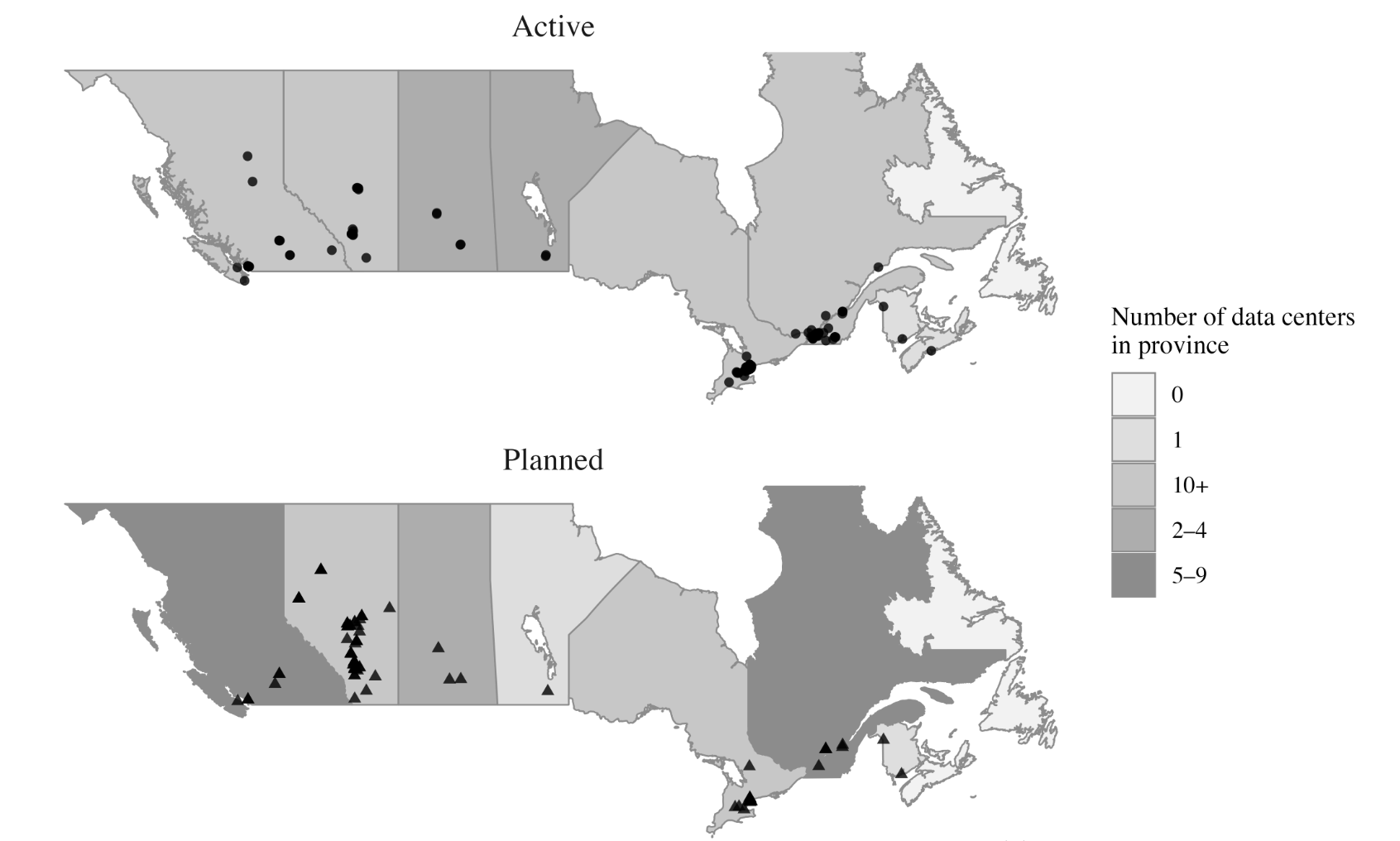
Using proprietary asset-level data tracking data centres across their full lifecycle—from announcement to construction to activation—we provide the first comprehensive mapping of Canada’s data centre landscape. Canada’s operational base remains modest, but the announced and under-construction pipeline is nearly an order of magnitude larger. This expansion is spatially concentrated and increasingly rural: Alberta accounts for over 90% of planned capacity despite a grid emissions intensity nearly five times the national average, raising questions about emissions trajectories and stranded asset risk. Quebec, Ontario, and British Columbia—which offer cleaner grids—have each introduced legislation constraining grid access for new large loads. Alberta, by contrast, pairs an evolving grid access framework with an active investment attraction strategy. Ownership of facilities is predominantly foreign, with direct implications for data sovereignty. Canadian pension funds have increased AI infrastructure exposure primarily through cloud and semiconductor equities rather than direct investment in data centre operators. Taken together, these patterns point to a discontinuous reallocation of electricity demand, land use, and capital with important implications for energy systems, regulatory institutions, and data sovereignty.
Available here: https://papers.ssrn.com/sol3/papers.cfm?abstract_id=6464099

